Tuesday, October 13, 2020

The Art of Tracking


I've had Louis Liebenberg's out-of-print book called The Art of Tracking in my Amazon wishlist for years. It stayed there because the only copies were going for more than $300.


Amazingly--and thankfully--it is now available for free download, along with Liebenberg's 2013 book, The Origin of Science. His introduction was timely in 2013 and even more so now that huge numbers of people seem to be losing the ability to think rationally, to follow sign all the way to its source the way our ancestors did in order to survive.


I look forward to finally being able to read these books!


From Liebenberg's introduction:

In this book I will address one of the great mysteries of human evolution: How did the human mind evolve the ability to develop science?

The art of tracking may well be the origin of science. Science may have evolved more than a hundred thousand years ago with the evolution of modern hunter-gatherers. Scientific reasoning may therefore be an innate ability of the human mind. This may have far-reaching implications for self-education and citizen science.

The implication of this theory is that anyone, regardless of their level of education, whether or not they can read or write, regardless of their cultural background, can make a contribution to science. Kalahari trackers have been employed in modern scientific research using GPS-enabled handheld computers and have co-authored scientific papers. Citizen scientists have made fundamental contributions to science. From a simple observation of a bird captured on a smart phone through to a potential Einstein, some may be better than others, but everyone can participate in science.

Today humanity is becoming increasingly dependent on science and technology for survival, from our dependence on information technology through to solving problems related to energy production, food production, health, climate change and biodiversity conservation. Involving citizens in science may be crucial for the survival of humanity over the next hundred years.

Scientific reasoning was part of hunter-gatherer culture, along with music, storytelling and other aspects of their culture. Science and art should be an integral part of human culture, as it has been for more than a hundred thousand years.

* * *

Sunday, October 11, 2020

Intimations


I wonder how long this mountain gnome will stick around. There was a notebook inside the white mailbox, but I didn't look at it. There was something slightly uninviting about reaching into the dark box to pull out the large dark notebook. I figured it was either a geocache or some other kind of visitor's register. I'll check it out next time I'm up there and slip a print of this picture in there.


Earlier in the morning I'd been watching the rising sun as it tried to break through thick layers of fog and cloud. The woods were dripping enough to make the ground wet, creating water shadows beneath the trees. Where there was no drip, the ground was dusty and dry. Where the drip was captured by moss, the moss had turned bright green. Beneath the dripping trees at Rock Spring, a banana slug, straight as a pencil, glided slowly over the surface of a picnic table.


The moisture, the moss, and the banana slugs were an intimation of wet weather to come. Hopefully we'll get the real thing before the month is out.


Last week all the news outlets eagerly announced that the season's first rain could be on its way. It's a great reminder of how complex nature really is, when the most modern meteorology, despite all of its measuring devices and supercomputers, often can't predict a change in the weather more than a day or two in advance.


Going through my past October images from Mt. Tam, there was a good amount of moisture on the mountain in 2010, '11, '12, and especially the latter part of the month in 2016. It's not that often that Cataract Creek is running while there's still fall color in the canyon maples.

On Friday I spent a lot of time chasing fogbows and hoping to find Inspector Brokken, but the right conditions didn't materialize.


Despite having no luck on that front, there was still a lot of beauty in the landscape.


A large covey of California quail also diverted me for a while.


They were difficult to approach, but if I remained still for a while, they'd slowly venture within camera range.


Surprisingly, this lovely, blue-tinged mourning dove didn't fly away when I staked out a quail-stalking position just a few feet away.


Not long after I left the quail, I saw a cooper's hawk down in a ravine. It hopped up onto a rock and fluffed its feathers awhile before flying over the ridge toward Bolinas. The sun broke through as I walked down a trail where the hawk had been. Its warmth lit up a couple dozen or so fluffy balls in a thicket of coyote brush that turned out to be white-crowned sparrows.


These deer were too busy browsing in the grass, so beautifully lit, to be overly bothered by my presence.


They eventually crossed a few feet in front of me to enter the woods through a little gnome hole in the branches. I walked over to look at the trail to see their hoofprints still sharp in the dust.

* * *

Saturday, October 10, 2020

Mono Lake


I always love going to Mono Lake, but I'll admit I like it best at dawn and sundown, and even in the middle of the night. I like it least in the middle of a hot and cloudless day. Mid-day is a good time to go have a picnic and siesta where shade can be found up at the County Park.


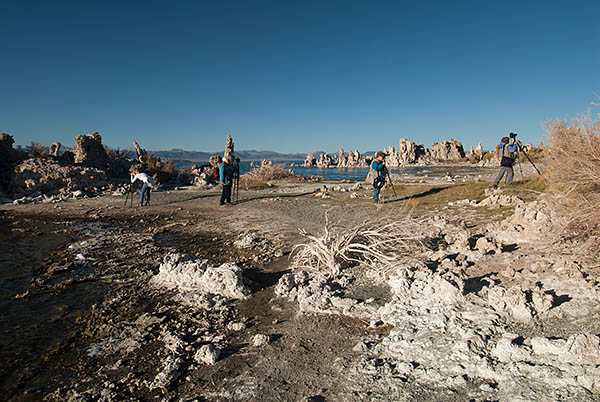
Photographers spread out along the shore in October 2008.


One of my favorite shots on that trip was taken far from the shore with a long lens. 


A herring gull makes a snack of brine flies.


Rabbitbrush near Black Point, with the volcanic domes of the Mono Craters area in the distance.


Migrating monarchs enjoy the nectar of rabbitbrush.


* * *