 |
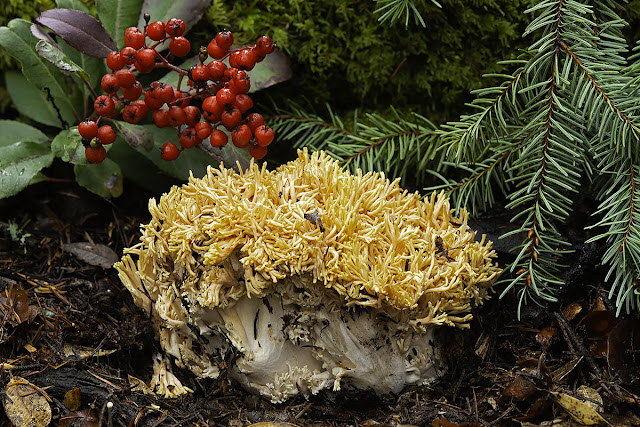
Coral Fungus & Christmas Berry Bouquet
(Click images to view larger.) |
Having asked Mt. Tamalpais to be my photographic muse for so many years, and having put closure (or something close to that) on those years of inspiration by creating a book with many of my favorite images (which I recently updated), I felt like it was time to give it a rest. Hard to believe that was around six years ago. Since then I've been hiking more with my wife instead of focusing on photography, although I still run a couple of trail cameras, and of course the smartphone/camera always comes along on our hikes. I also like to ride up to Mt. Tam on my ebike when it's time to check up on the trail cams, something I started doing early in the pandemic when the mountain was closed to cars.
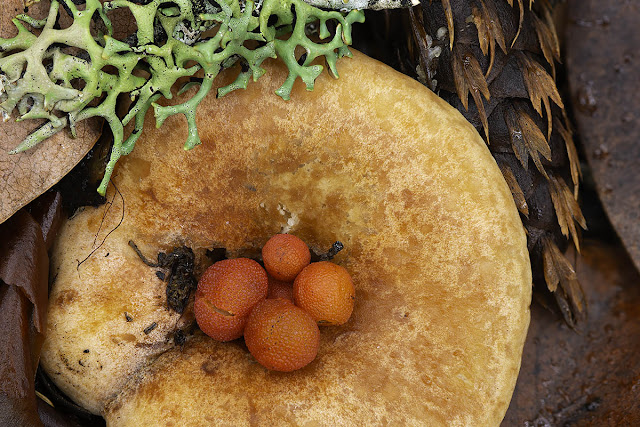 |
| Madrone Berries in Mushroom Cap Bowl |
So yesterday I drove up with my camera gear to poke around in the woods, partly inspired by a book I just finished reading for the second time, called The Invention of Nature - Alexander von Humboldt's New World, by Andrea Wulf. Humboldt collected enough natural history data during his five-year adventure to generate a lifetime of books, studies, and lectures on what he found. He inspired a younger Darwin to set sail on the Beagle, and he inspired Thoreau to make Walden a classic of literature instead of a dry tally of observations.
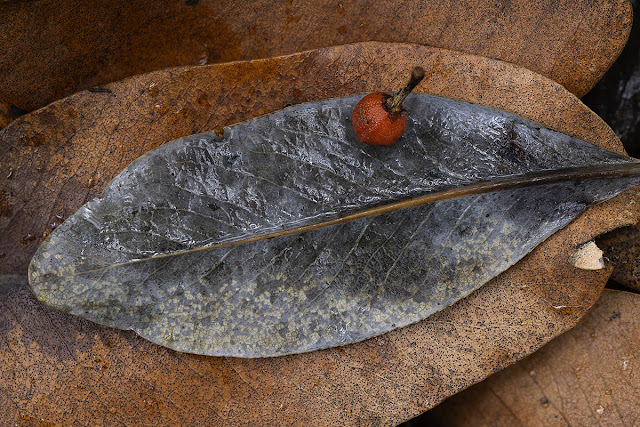 |
| Silvery Madrone Leaf |
I picked up one of Humboldt's books, Views of Nature, but haven't begun reading it yet. I'm hoping to find some inspiration in there for when I eventually return to blogging more regularly. In any event, I began my stroll in the Tamalpais woods beneath a canopy of madrones. The forest floor was littered with leaves and countless berries, most of which were already fading to black as chemistry and forest decomposers went to work on them. I've seen flocks of band-tailed pigeons feeding on madrone berries in the past, but I wondered about the seeming overproduction of fruit as I stood in a forest with no apparent birds around. Just the sound of light rain striking leaves in the canopy above and on the ground at my feet.
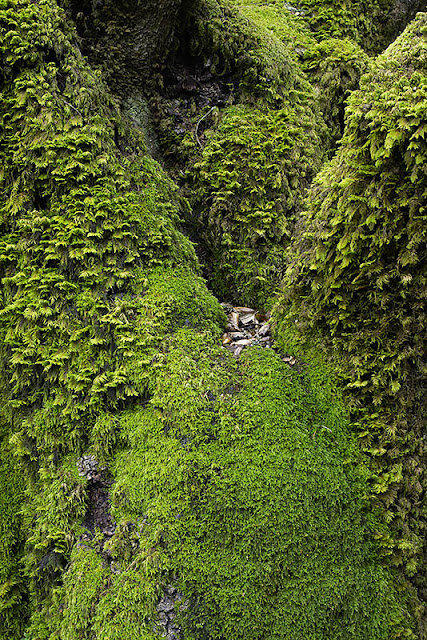 |
| Grandfather Oak Covered With Moss |
I was glad I'd brought an umbrella, and also that I'd dressed more warmly than I do when I'm hiking. Even so, after a few hours of poking around, with knees good and muddied, I was chilled to the bone. I thought of Humboldt and his love for data and chided myself for forgetting to bring a thermometer.
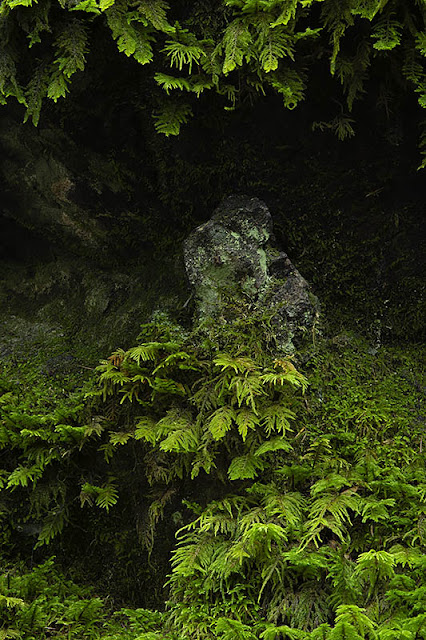 |
| Faerie Cave |
A camera can be a fine instrument for collecting scientific data, but I confess to being more interested in the subjective business of recording inner impressions. The emerald-colored cave above struck me right away, but I only wanted to make one photograph in the large group of mossy boulders, so I set down my camera gear and walked around to see if some other part of the jumble would call even louder. None did.
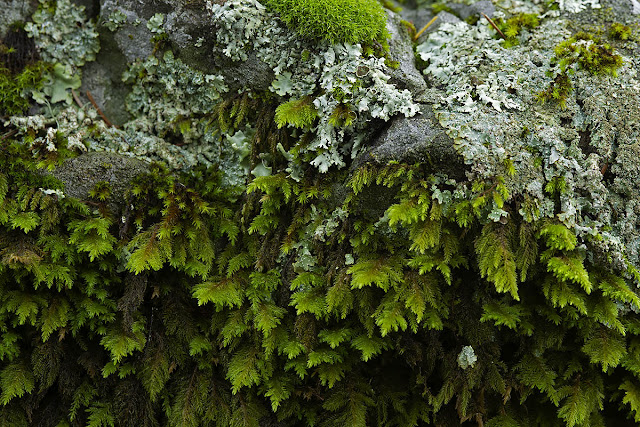 |
| Moss and Lichen Colonizing a Rock |
But the moss wasn't done with me yet! As I continued on my wander of wonder I was again drawn to a mossy landscape-in-miniature. All these incredible life forms, and all metabolizing in high gear, doing all the necessary work of growing, finding security, and casting the next generation into the world, while the rain lasts.
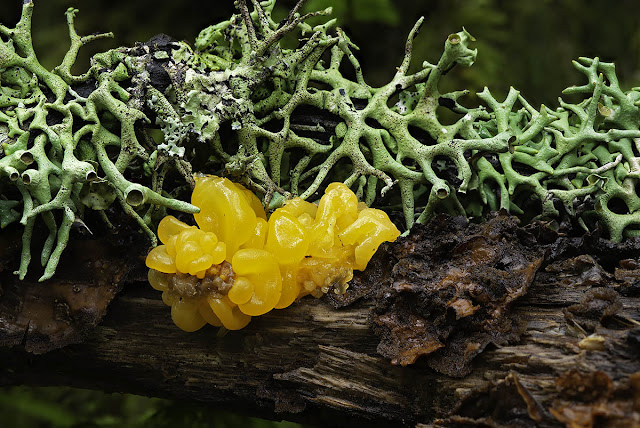 |
| Witch's Butter |
There are two different species called witch's butter, and according to California Mushrooms (Desjardins, et al.) the two are not closely related. When I saw this still-fresh-looking specimen I wanted to photograph it in a way that would show which species this is. I remembered that Tremella aurantia is a parasite on Stereum hirsutum and wanted to include both species in the shot. The thing is, I'm not sure I've actually done that here since I don't know without a doubt that the somewhat decayed, leafy fruitbodies next to the witch's butter are actually Stereum. I also didn't remember to try to figure out if the branch of wood it's growing on was Douglas fir or tanoak (the two most likely suspects for softwoood vs. hardwood), which is another diagnostic characteristic to separate Tremella from its distant cousin Dacrymyces chrysospermus.
 |
| Amanita Cleansed of Her Warts |
I think this is either Amanita gemmata or something close to it, despite the lack of veil remnant "warts" on its cap. A close examination does show faint white dots on the cap. I figure the warts have been washed off in all the rain. I was interested in the scrape mark on the cap. Was it created by a passing banana slug? Or did it somehow get scraped by bark as the mushroom forced its way up from its thready mycelial origin beneath the forest duff? If I lean toward the slug scrape, I wonder why so little was eaten. I wonder if a slug senses a chemical reaction that warns it off a potentially poisonous meal.
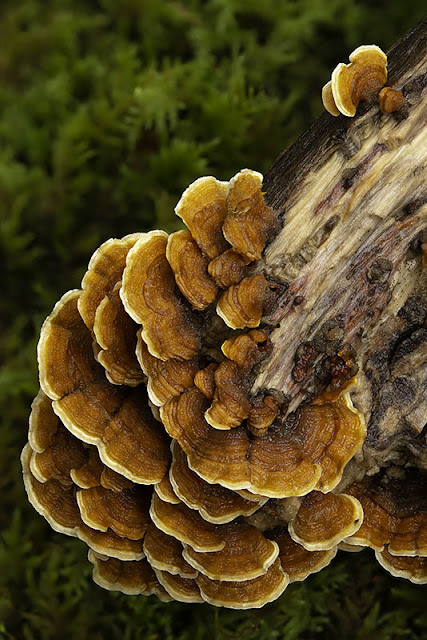 |
| Turkey Tails |
I recently found a gorgeous fruiting of turkey tails on a hike with my wife along the side of Bolinas Ridge, and of course I took a picture with my camera phone, but I was hoping to find something just as nice with my DSLR. I didn't see anything as big as that, but this patch growing out the end of a fallen branch was fresh enough and just big enough to entice me. I'm not sure what the reddish tinge on the wood comes from, but it reminds me of a photo I took of a red droplet hanging from a fungus that my botany teacher at Santa Barbara City College also thought was curious, and he simply called it "some kind of metabolic byproduct." Mushroom poop.
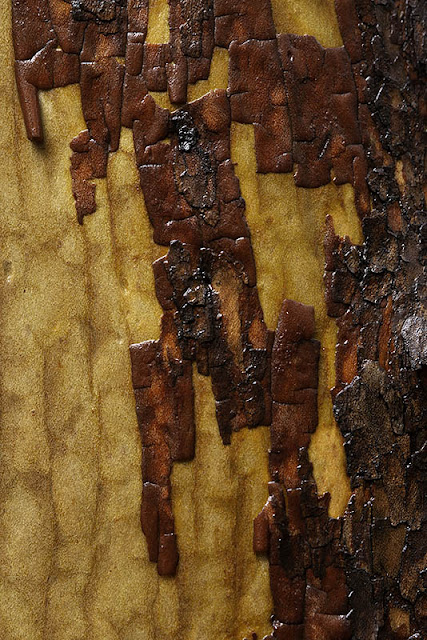 |
| Abstract on Madrone |
These patterns of bark reminded me of Kandinsky paintings for some reason. I've photographed this same stand of madrones several times. In the summer the bark that's tan in this view sometimes turns green. Moss tries to colonize madrone but can only maintain a foothold until the outer layer of bark peels off.
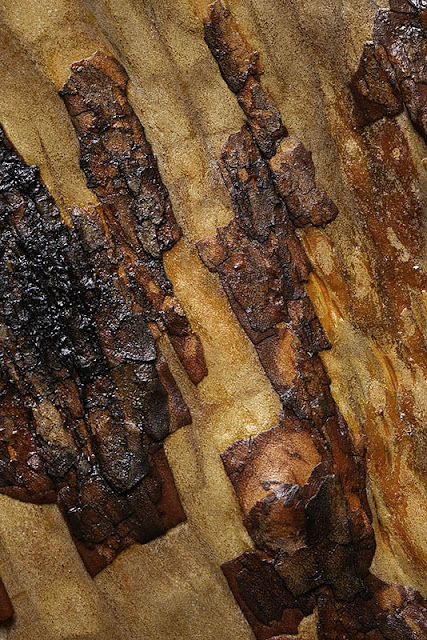 |
| Abstract #2 |
With so many potential compositions, I decided, as I did back at the mossy boulder field, to limit myself to just a few. I was also close to shivering by this time and was eager to get back to the car. I enjoyed getting out to do some photography with my DSLR once again since it's been awhile, and I appreciated having more time than I take while hiking to contemplate the life of the woods—what it means to me spiritually as well as its power to enliven my curiosity about its fascinating intricacies—that is the subject matter for any nature photographer.




 Posts
Posts


