A bee's-eye view.
 |
| (Click images for larger view.) |
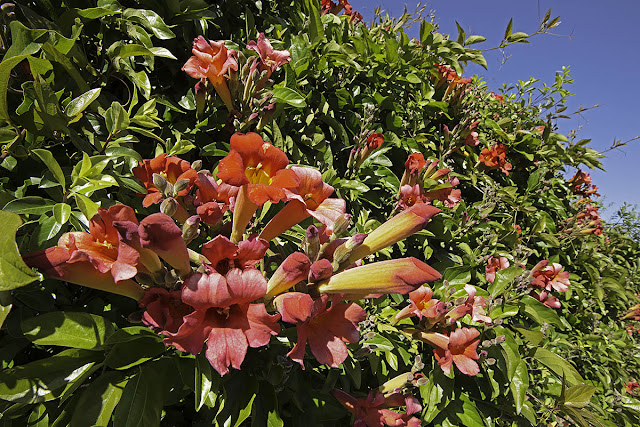
The neighbors across the street have created a living privacy fence with this densely leaved Red Trumpet Vine (Distictis buccinatoria), which recently began blooming like crazy. It looks like something that might be pollinated by hummingbirds, but I confess that I haven't noticed any when I've walked past it. Distictis is in the Bignoniaceae family, like one of my favorite trees, the jacaranda, whose blossoms turned a street near a friend's house in Santa Barbara into purple tunnels.
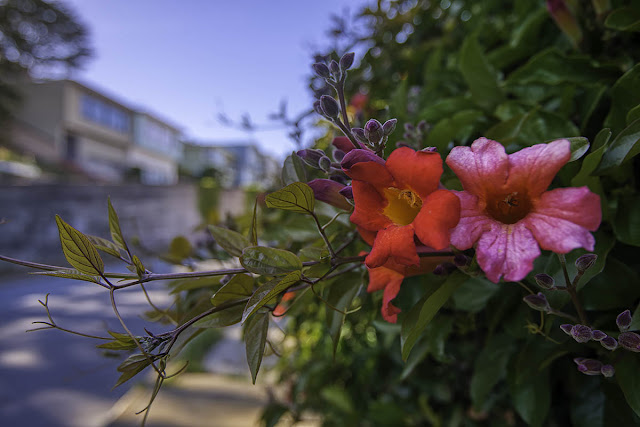
My neighborhood walks take me past the vine three times a day, and on yesterday's early walk, while it was still dark outside, I spotted a coyote trotting toward me just a second before he spotted me and turned around.
This was the second morning in a row that I encountered a coyote on my early walk. I told my wife about it when I got back home just as she was going out the door to walk to work. No sooner had she closed the gate when she came back to tell me the coyote was out front. He trotted up the street ahead of my wife, turning often to see if she was still coming, and paying little heed to the mob of raucous ravens cawing at him from rooftops, trees and telephone poles.
The two-lobed stigma (in the back, looking like an ostrich head) opens to receive pollen, then closes when it gets enough to fertilize its ovules.
A fresher corolla tube.
Now that I've finally taken a close look at these flowers after living near them for many years, I'll have to spend some time watching for visiting hummingbirds. The nectaries are a long way down that tube, so it might be a pretty good show. Once I determined that this plant is non-toxic I touched the tip of my tongue to the base of the stamens and tasted the sweet nectar. [After the sun came out I checked and saw no hummingbirds visiting, but plenty of honeybees, who mostly gathered pollen but occasionally went deep into the tube for nectar, and bumblebees, who made straight for the nectar, but became so dusted with pollen on the way in and out that pollen cascaded from their backs when they emerged.]
In this crop of the previous image you can see hairs on the outside of the corolla tube, maybe making it more reflective to keep it from overheating and endangering the nascent seeds within. Even the style (the stalk of the stigma) had hairs on it.
When I opened Helicon Focus to create these focus-stacked images I was surprised to learn that the company is based in Kharkiv, Ukraine. Their web site lists several ways to donate money to the war effort.
* * *


 Posts
Posts


