Wednesday, April 6, 2022

Bioscapes

(Click images to view larger.)

I like to admire and photograph landscapes as much as the next guy, but I've always been especially drawn to "bioscapes" -- the intimate details of nature. I want to see indigo anthers that haven't fully opened up yet, and others that have exploded with orange pollen grains. I only wish I could render even greater detail, and one of these days I'm going to buy a stereo microscope so I can do just that.


When you start with a landscape, you might pick out individual trees, a river, a wildflower meadow, a section of cliff face, or the peak of a mountain. The bioscape is where you get to the level that isn't available to your unaided eyes. It's like peering into a realm of fantasy, except it's even better because it's real. Somehow -- and no one knows how -- this universe that got its start billions of years ago contained within its initial conditions the ability of atomic elements to organize themselves into living creatures. The intricacy of life is literally mind-boggling, and when I'm doing close-up photography I'm giving my imagination free rein to roam in those intricate worlds.


Come to think of it, it was staring at anthers and trichomes and other botanical fare through dissection microscopes in a botany class in college that first sparked my interest in close-up photography. One day I was out doing nature photography and was awed by the beauty of a species of monkey flower with wildly colorful nectar guides. To better appreciate them I dissected a flower, then set a sheet of glass over the parts to make them lie flat enough to be photographed (this was long before the days of digital photography and focus stacking).


Mimulus cardinalis

* * *

Monday, April 4, 2022

Looking for Compromise


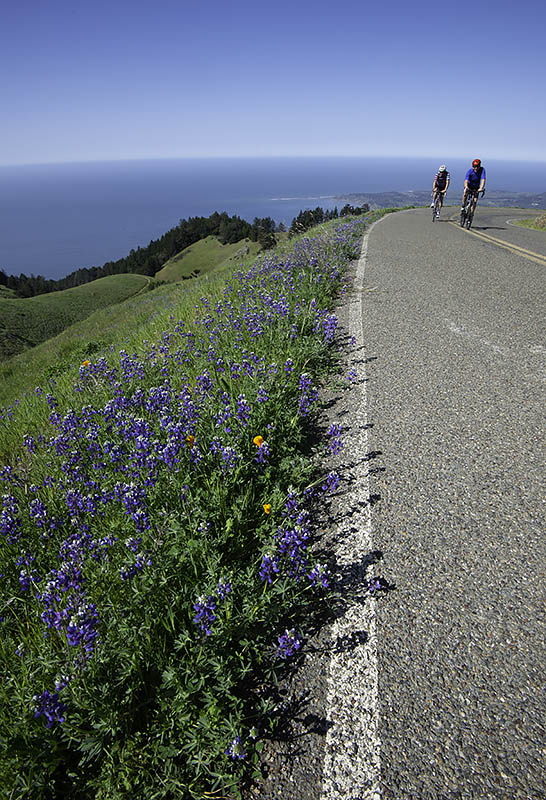
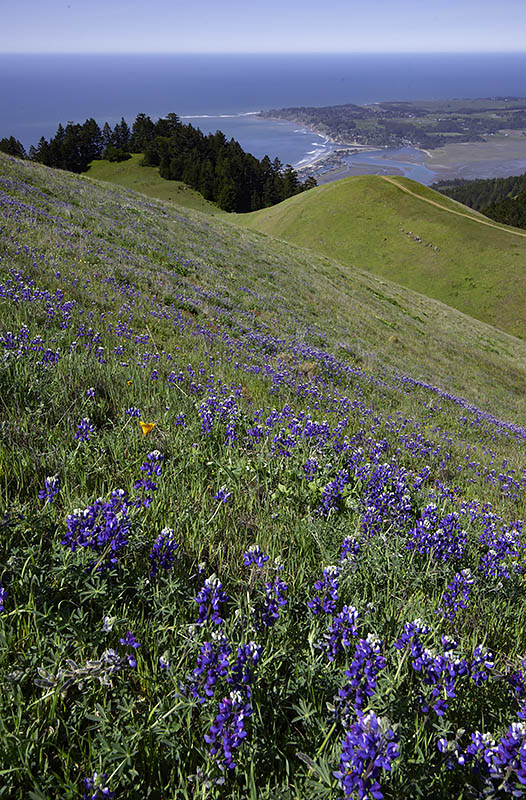
Lying in the dark during the pre-dawn hours of Sunday morning I contemplated driving up to Mt. Tam to find a patch of lupines to photograph with the sunrise. I'd just been up there last week, though, and I couldn't recall seeing a patch that would give me a good vantage point. That meant I'd have to try to find one on the fly, hurrying along after the 7 a.m. gate opening, looking for something that may well not exist. I concluded that such a quest would be futile and require an unnecessary trip in the car, and soon fell back to sleep.


When I finally woke up for good I decided to ride my e-bike up to Mt. Tam. I wanted to update my recent "Then & Now" post with another photo that required the use of my DSLR and 16-35mm lens, so I also had an opportunity to try out something else I've been thinking about. 


I've been wondering if I could continue to pursue my interest in nature photography within an area bounded by the limit of my e-bike range. My carbon footprint would be reduced compared with driving my car, and I'd get some great exercise. I'd compromise speed and range for physical and environmental health.


The result of my little test with the DSLR on Sunday was that it's possible, but I'm not quite prepared equipment-wise. I could easily add a 105mm Micro to my bike kit, but I would still really miss having a tripod. My current tripod is too long and heavy for the bike, so I'd have to find something smaller. 


On the way home I was excited to find this gas station with prices exceeding the $6.00 mark. The last time I bought gas it was $4.65/gal., which I thought was outrageous. We don't drive much, so we've missed the big run-up since Russia's invasion of Ukraine. Judging by the traffic I see in the city, especially along 19th Avenue, it doesn't appear that high prices are making much of a dent in people's need or desire to drive. 

The news media and the president focus their hand-wringing on the high prices, but I never hear them suggest that people try to drive less. I suspect to most people the idea of not using their car every day just boggles the mind, like going vegetarian. It makes me think of Dr. Strangelove: how I stopped worrying and learned to love climate change.

* * *

Saturday, April 2, 2022

Backyard Beauties


The Miner's Lettuce (Claytonia perfoliata) out back has the advantage over its wild kin of having been watered more than nature provided this season.


The basal rosette of this plant, like the many neighbors in its patch, was about as big around as the palm of my hand.


Although it's a very good edible plant, this one ended up in a small vase on the window ledge over our kitchen sink.

* * *