Tuesday, April 19, 2022

Bug Bites


I just dug up one of my wife's aphid-infested plants, recently brought home from the nursery, and unceremoniously dumped it in the compost bin for tomorrow morning's pick-up.

Along with the winged adult captured above, you can see hints of much more infestation on the bottom of this sage leaf. The top surface was littered with what appeared to be countless tiny, spherical white eggs. Several of the leaves had white splotches of powdery mildew, which drew our eyes at first. The aphids showed up on closer examination. The sage was in a window box planter between a lavender and a rosemary, both of which appear to be unscathed by either the aphids or the fungus.

I was a little disappointed with the clarity of the 1:1 images I shot with a Nikon 105mm/Micro despite using a flash and bracing myself. Next I tried running a focus stack with my camera on a tripod, but I didn't lock up the mirror since I was using flash, and those images were even worse. The mirror-slap vibrations at that magnification were all too evident. I didn't have time to keep testing, so I'll have to experiment with capturing such tiny creatures a bit more on another day.

* * *

Saturday, April 16, 2022

Native of Mexico


A bee's-eye view.


(Click images for larger view.)

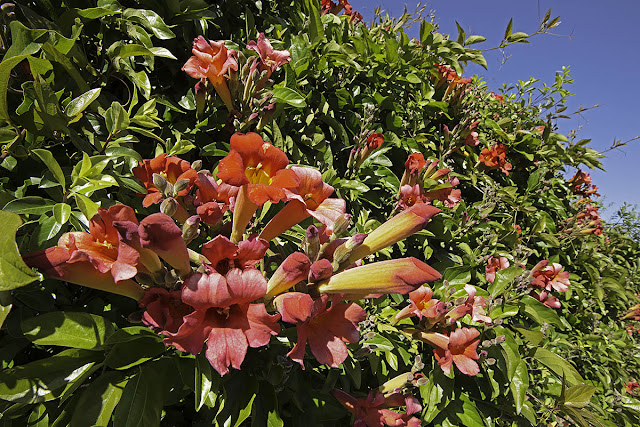
The neighbors across the street have created a living privacy fence with this densely leaved Red Trumpet Vine (Distictis buccinatoria), which recently began blooming like crazy. It looks like something that might be pollinated by hummingbirds, but I confess that I haven't noticed any when I've walked past it. Distictis is in the Bignoniaceae family, like one of my favorite trees, the jacaranda, whose blossoms turned a street near a friend's house in Santa Barbara into purple tunnels.
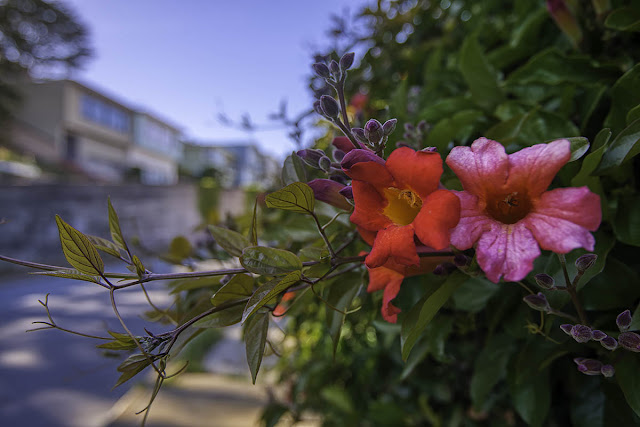

My neighborhood walks take me past the vine three times a day, and on yesterday's early walk, while it was still dark outside, I spotted a coyote trotting toward me just a second before he spotted me and turned around. 

This was the second morning in a row that I encountered a coyote on my early walk. I told my wife about it when I got back home just as she was going out the door to walk to work. No sooner had she closed the gate when she came back to tell me the coyote was out front. He trotted up the street ahead of my wife, turning often to see if she was still coming, and paying little heed to the mob of raucous ravens cawing at him from rooftops, trees and telephone poles.


The two-lobed stigma (in the back, looking like an ostrich head) opens to receive pollen, then closes when it gets enough to fertilize its ovules.


A fresher corolla tube.


Now that I've finally taken a close look at these flowers after living near them for many years, I'll have to spend some time watching for visiting hummingbirds. The nectaries are a long way down that tube, so it might be a pretty good show. Once I determined that this plant is non-toxic I touched the tip of my tongue to the base of the stamens and tasted the sweet nectar. [After the sun came out I checked and saw no hummingbirds visiting, but plenty of honeybees, who mostly gathered pollen but occasionally went deep into the tube for nectar, and bumblebees, who made straight for the nectar, but became so dusted with pollen on the way in and out that pollen cascaded from their backs when they emerged.]


In this crop of the previous image you can see hairs on the outside of the corolla tube, maybe making it more reflective to keep it from overheating and endangering the nascent seeds within. Even the style (the stalk of the stigma) had hairs on it.

When I opened Helicon Focus to create these focus-stacked images I was surprised to learn that the company is based in Kharkiv, Ukraine. Their web site lists several ways to donate money to the war effort.

* * *

Wednesday, April 13, 2022

Fast Times


Looking out the back window late this morning, my impression was that the clouds were not moving at all. Only when I looked more carefully and used Sutro Tower as a reference point was it apparent that the clouds were lazily sweeping north to south. I set up the DSLR to capture the movement in a timelapse with frames firing every two seconds. 

Normally I have little patience to hang around during a long timelapse, but this time I was able to set it up in the bedroom, then close the door and return to the living room where I could work at my computer without having to listen to the noisy mirror-slap of each frame. 

Maybe there's a mirrorless camera in my future. 

I do enjoy watching clouds in timelapse mode. All that churning and roiling of fluid, chaotic, and evanescent shapes is mesmerizing. I also like to watch other slow things in nature that have been sped up, like plants and mushrooms growing. On the other hand, it's also interesting to see fast things slowed down, like a ladybird beetle taking flight.

Whenever I want a quick fix of timelapsed clouds I run the latest hour captured by various fire lookouts around the state, like these in the Tahoe region or these in the North Bay.

* * *

Wednesday, April 6, 2022

Bioscapes

(Click images to view larger.)

I like to admire and photograph landscapes as much as the next guy, but I've always been especially drawn to "bioscapes" -- the intimate details of nature. I want to see indigo anthers that haven't fully opened up yet, and others that have exploded with orange pollen grains. I only wish I could render even greater detail, and one of these days I'm going to buy a stereo microscope so I can do just that.


When you start with a landscape, you might pick out individual trees, a river, a wildflower meadow, a section of cliff face, or the peak of a mountain. The bioscape is where you get to the level that isn't available to your unaided eyes. It's like peering into a realm of fantasy, except it's even better because it's real. Somehow -- and no one knows how -- this universe that got its start billions of years ago contained within its initial conditions the ability of atomic elements to organize themselves into living creatures. The intricacy of life is literally mind-boggling, and when I'm doing close-up photography I'm giving my imagination free rein to roam in those intricate worlds.


Come to think of it, it was staring at anthers and trichomes and other botanical fare through dissection microscopes in a botany class in college that first sparked my interest in close-up photography. One day I was out doing nature photography and was awed by the beauty of a species of monkey flower with wildly colorful nectar guides. To better appreciate them I dissected a flower, then set a sheet of glass over the parts to make them lie flat enough to be photographed (this was long before the days of digital photography and focus stacking).


Mimulus cardinalis

* * *

Monday, April 4, 2022

Looking for Compromise


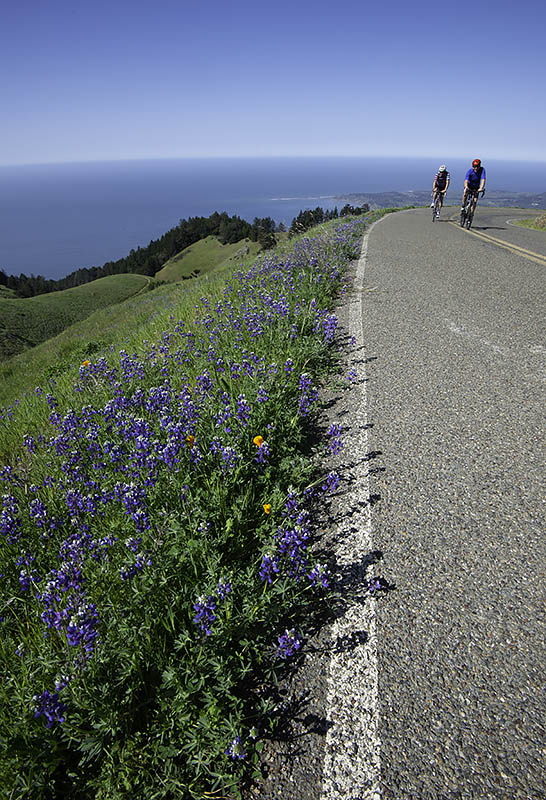
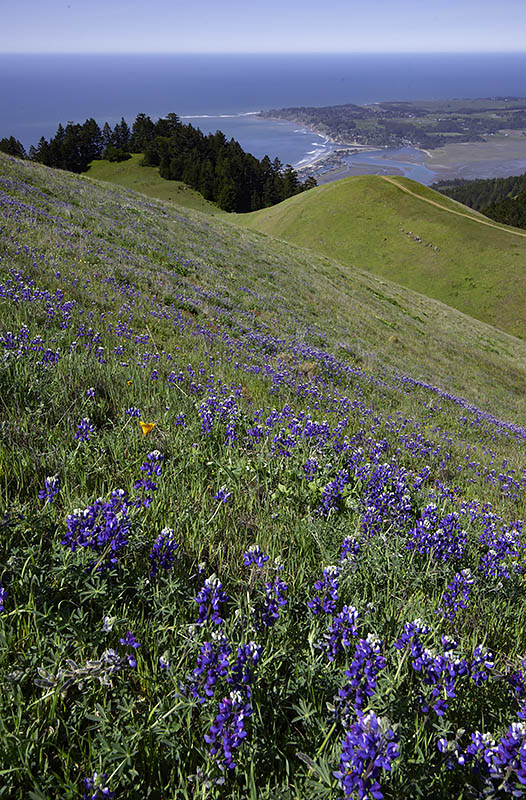
Lying in the dark during the pre-dawn hours of Sunday morning I contemplated driving up to Mt. Tam to find a patch of lupines to photograph with the sunrise. I'd just been up there last week, though, and I couldn't recall seeing a patch that would give me a good vantage point. That meant I'd have to try to find one on the fly, hurrying along after the 7 a.m. gate opening, looking for something that may well not exist. I concluded that such a quest would be futile and require an unnecessary trip in the car, and soon fell back to sleep.


When I finally woke up for good I decided to ride my e-bike up to Mt. Tam. I wanted to update my recent "Then & Now" post with another photo that required the use of my DSLR and 16-35mm lens, so I also had an opportunity to try out something else I've been thinking about. 


I've been wondering if I could continue to pursue my interest in nature photography within an area bounded by the limit of my e-bike range. My carbon footprint would be reduced compared with driving my car, and I'd get some great exercise. I'd compromise speed and range for physical and environmental health.


The result of my little test with the DSLR on Sunday was that it's possible, but I'm not quite prepared equipment-wise. I could easily add a 105mm Micro to my bike kit, but I would still really miss having a tripod. My current tripod is too long and heavy for the bike, so I'd have to find something smaller. 


On the way home I was excited to find this gas station with prices exceeding the $6.00 mark. The last time I bought gas it was $4.65/gal., which I thought was outrageous. We don't drive much, so we've missed the big run-up since Russia's invasion of Ukraine. Judging by the traffic I see in the city, especially along 19th Avenue, it doesn't appear that high prices are making much of a dent in people's need or desire to drive. 

The news media and the president focus their hand-wringing on the high prices, but I never hear them suggest that people try to drive less. I suspect to most people the idea of not using their car every day just boggles the mind, like going vegetarian. It makes me think of Dr. Strangelove: how I stopped worrying and learned to love climate change.

* * *